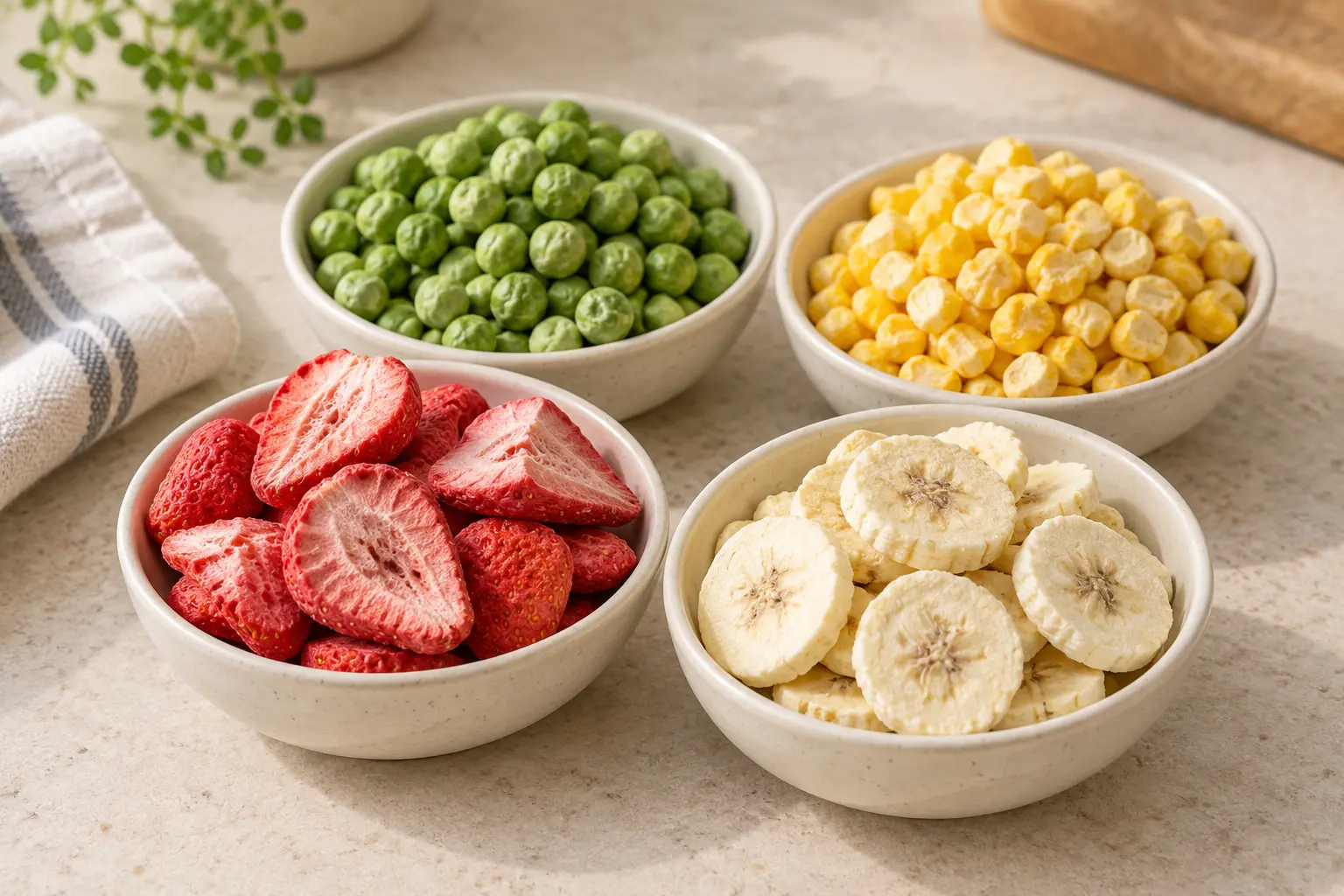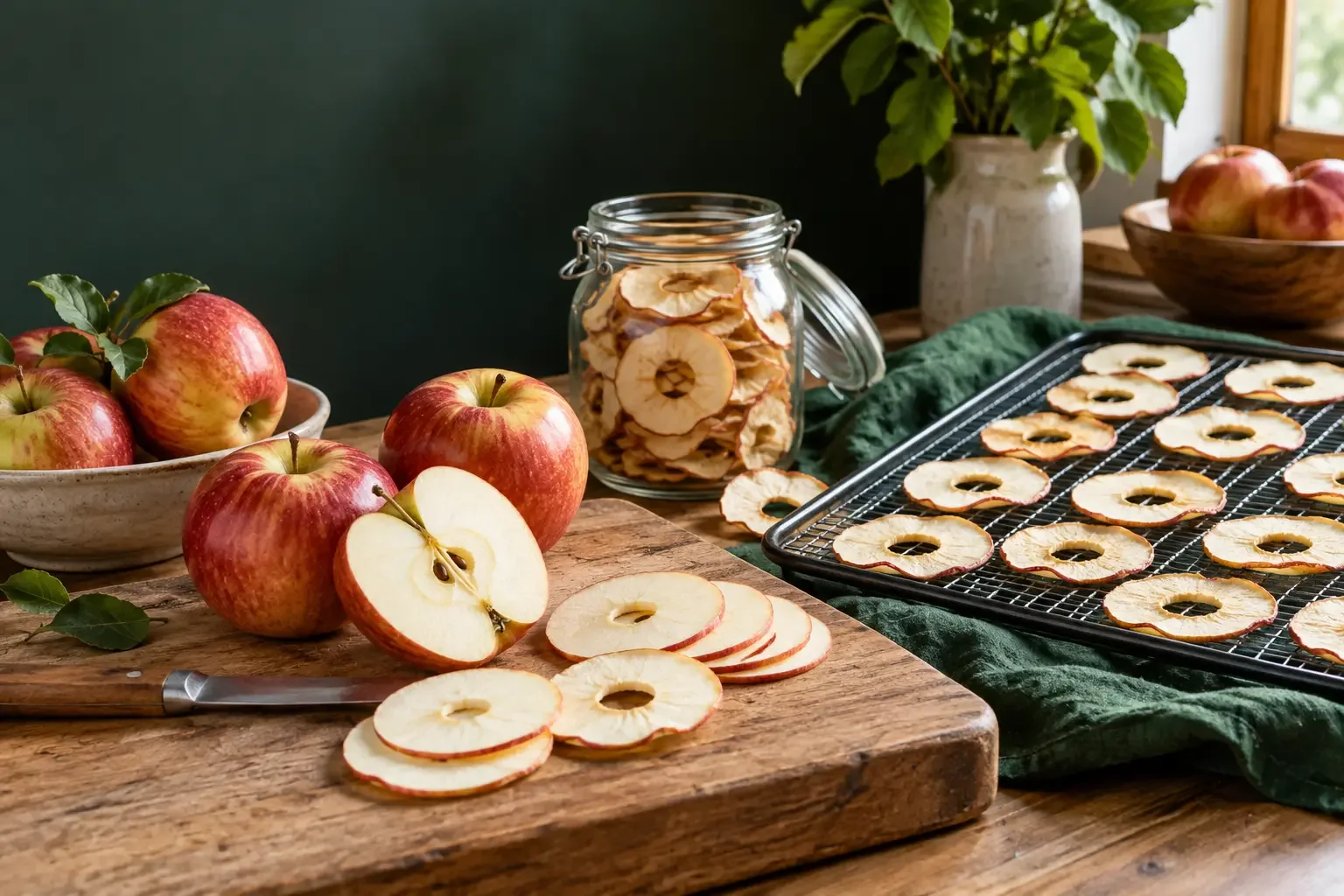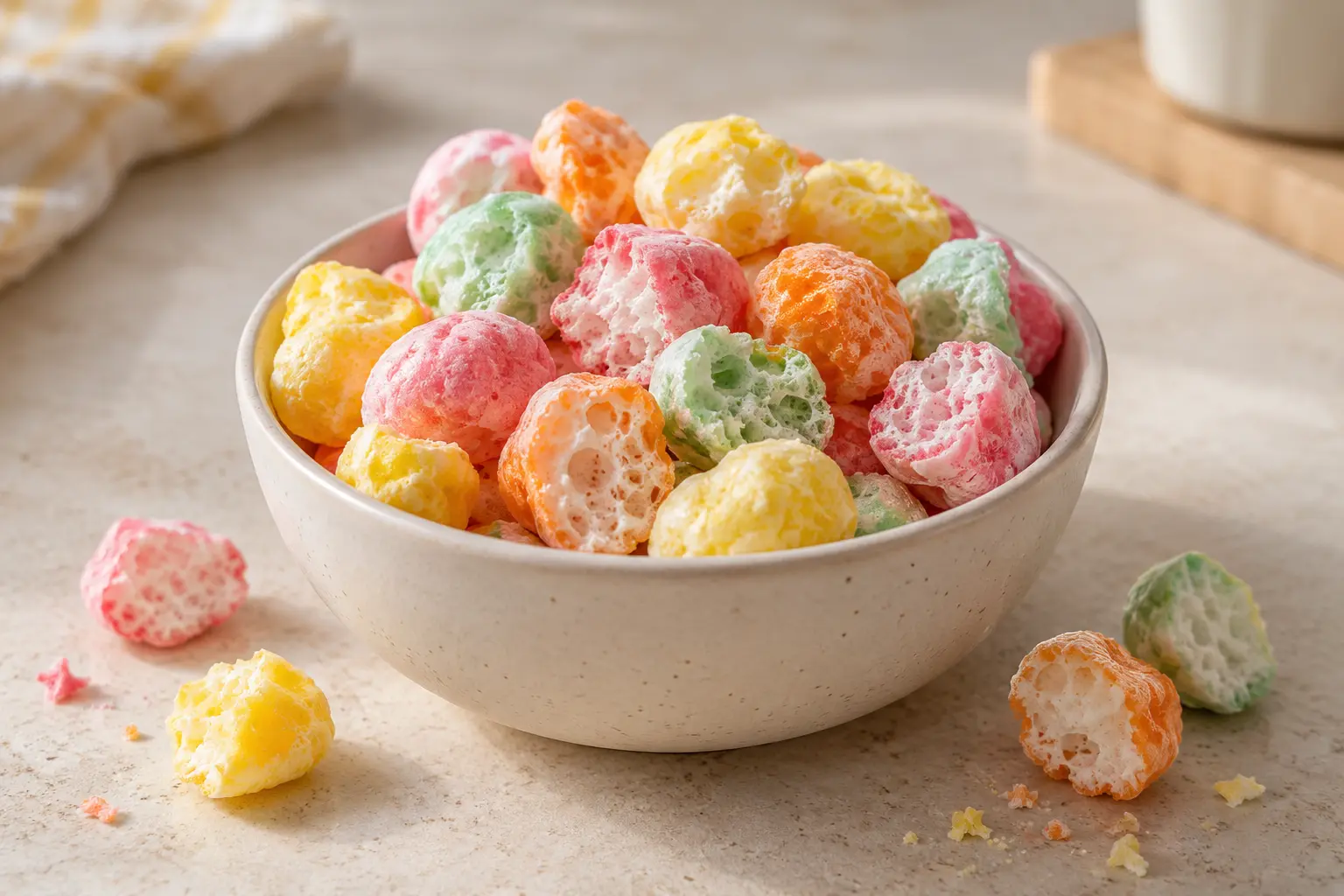
You need a real freeze dryer
True freeze-drying combines freezing with controlled vacuum so ice can leave as vapor through sublimation.
A freezer, dehydrator or air fryer is a different process
Cold or warm airflow alone does not reproduce the controlled vacuum stage that defines freeze-drying.
SAFETY GUIDE · SAFETY PASSPORT
Five rules that keep a candy batch on track
Electrical note: the highlighted Varmbake listing is 220V. Verify the exact plug, circuit and installation requirements before purchase.
THE PROCESS
What freeze-drying actually does to candy
Freeze-drying is not just very cold drying. A true freeze dryer first freezes the product, then lowers pressure so frozen water can leave as vapor through sublimation. That freezing-and-vacuum sequence is the core of the method.
Candy reacts differently depending on sugar, water, acids, gelatin, starches, fats and trapped gases. Some candies expand or crack open; others barely change. The goal is a reproducible dry texture, not a promise that every candy will puff.

NO SHORTCUT
Do you need a freeze dryer to make freeze-dried candy?
Yes. True freeze-dried candy needs equipment that can freeze the product and create the vacuum conditions required for sublimation. A kitchen freezer, dehydrator, oven, air fryer or dry ice alone does not reproduce that controlled process.
If candy is the only thing you plan to make, be conservative about buying a machine. The purchase makes more sense when candy is one use case among fruit, vegetables, ingredients or meals.
Not a U.S. household recommendation: this listing specifies 220 V / 50 Hz and 1800 W, rather than the usual U.S. 120 V / 60 Hz supply. Its vacuum and freezing performance have not been independently verified here. A plug adapter does not resolve voltage or frequency compatibility; confirm the exact machine and installation with the manufacturer before considering it.
 CHECK MACHINE AND ELECTRICAL COMPATIBILITY
Varmbake Vacuum Freeze Dryer Machine — 6 Trays, 220V / 1800W*
Seller-described equipment reference, retained for identification only. This model is excluded from our U.S. household equipment recommendations.
Inspect the seller listing and specifications →Affiliate link · listing specs can changeFIRST BATCH
Best candy to freeze dry: start with clear feedback
For a first batch, choose one candy type that is easy to space and inspect. Sugar-based chewy or aerated candies often show the clearest texture change. Keep the variables simple so you can learn how your machine behaves.
| Candy type | What you may see | Beginner fit | Prep note |
|---|---|---|---|
| Skittles-style candy | Shell may split; center can become crisp and porous | High | Single layer; room around pieces |
| Saltwater taffy / fruit chews | Can expand dramatically and turn brittle | High | Use a compatible liner when helpful |
| Gummy candy | Often lighter and crunchier; recipe-dependent | Medium–High | Keep pieces separated |
| Marshmallows | Usually very crisp and light | High | Easy center check |
| Chocolate-heavy candy | Limited change; may stay dense or oily | Low | High fat is challenging |

Candy that often disappoints
Chocolate-heavy, very fatty or layered candies are weaker first-batch choices. Dense caramels, nougats and coatings can behave differently from their centers. Test small amounts instead of inventing a universal temperature.
SETUP
What you need before you start
You need a real freeze dryer, clean trays, compatible liners when useful and packaging that can be closed promptly after a verified-dry batch. Accessory compatibility is not interchangeable across brands.
Affiliate disclosure: The product links below are Amazon affiliate links. As an Amazon Associate, we earn from qualifying purchases. Your price does not change.
 HARVEST RIGHT ACCESSORY
Silicone Tray Stackers — 16 Pieces*
For organizing compatible Harvest Right trays. Verify your exact tray model.
View on Amazon DISPOSABLE LINER
SMARTAKE Parchment Sheets — 12 × 16 in, 200 Count*
A generic disposable liner for sticky candy when the sheet fits your tray.
View on Amazon REUSABLE LINER
Silicone Baking Mats — 4 Pack, Harvest Right Compatible*
Reusable mats marketed for compatible Harvest Right trays. Verify exact size.
View on AmazonAffiliate links · Your price stays the same.
STEP BY STEP
How to freeze-dry candy at home: 7 steps
Check your exact machine and software
Read the current manual and workflow before copying a setting from another owner or brand.
Choose one candy type
Remove wrappers and keep the first load simple so expansion and doneness are easier to diagnose.
Load a single layer
Leave practical room for expansion. Use a compatible liner only when it fits your tray and machine instructions.
Run the documented candy or freeze-dry cycle
If your machine has Candy Mode, follow its current instructions. Otherwise use the documented process for your unit.
Check the largest pieces
When the cycle finishes, inspect representative large or dense pieces. A timer or dramatic puff is not proof of a dry center.
Add dry time when the center is questionable
If a sample is cool, soft, gummy or obviously moist inside, follow your machine’s extra-dry procedure.
Package promptly after the dry check passes
Move the verified-dry candy into dry airtight packaging and close it promptly to limit humidity pickup.
BATCH PASS
Six checks before you unload
MACHINE-SPECIFIC
Candy Mode vs. a standard freeze-dry cycle
Candy Mode is a manufacturer and software feature, not an industry-wide recipe. Follow the current instructions for the machine in front of you. Do not transplant one brand’s temperature limits or cycle values into another unit.
DONENESS
How do you know freeze-dried candy is done?
Use the largest and densest pieces as your reality check. The finished texture may be crisp, porous, brittle or very light. What you do not want is a center that still feels cool, gummy or obviously moist.
If needed, use your machine’s extra-dry function. Once the batch passes, move into packaging without leaving trays exposed in a humid kitchen.
TROUBLESHOOTING
7 common freeze-dried candy mistakes — and the better move
Better move: one layer, room to expand, smaller first batch.
Better move: use your exact manual and software instructions.
Better move: separate candy types until you know their behavior.
Better move: learn on a simpler sugar-based candy first.
Better move: check the largest piece and add dry time when needed.
Better move: portion and close dry packaging promptly.
Better move: verify tray dimensions and model compatibility.
Why freeze-dried candy turns sticky or chewy
The center may have left the machine with residual moisture, or fully dry candy may have absorbed humidity after the cycle. If the candy was crisp when removed but becomes tacky later, focus on packaging speed and seal quality. Packaging cannot correct an under-dried center.
MOISTURE CONTROL
How to store freeze-dried candy without making shelf-life promises
The practical storage goal is texture protection: keep finished candy dry, minimize humid-air exposure and use packaging that closes reliably. We intentionally avoid blanket “years of shelf life” promises for homemade batches.
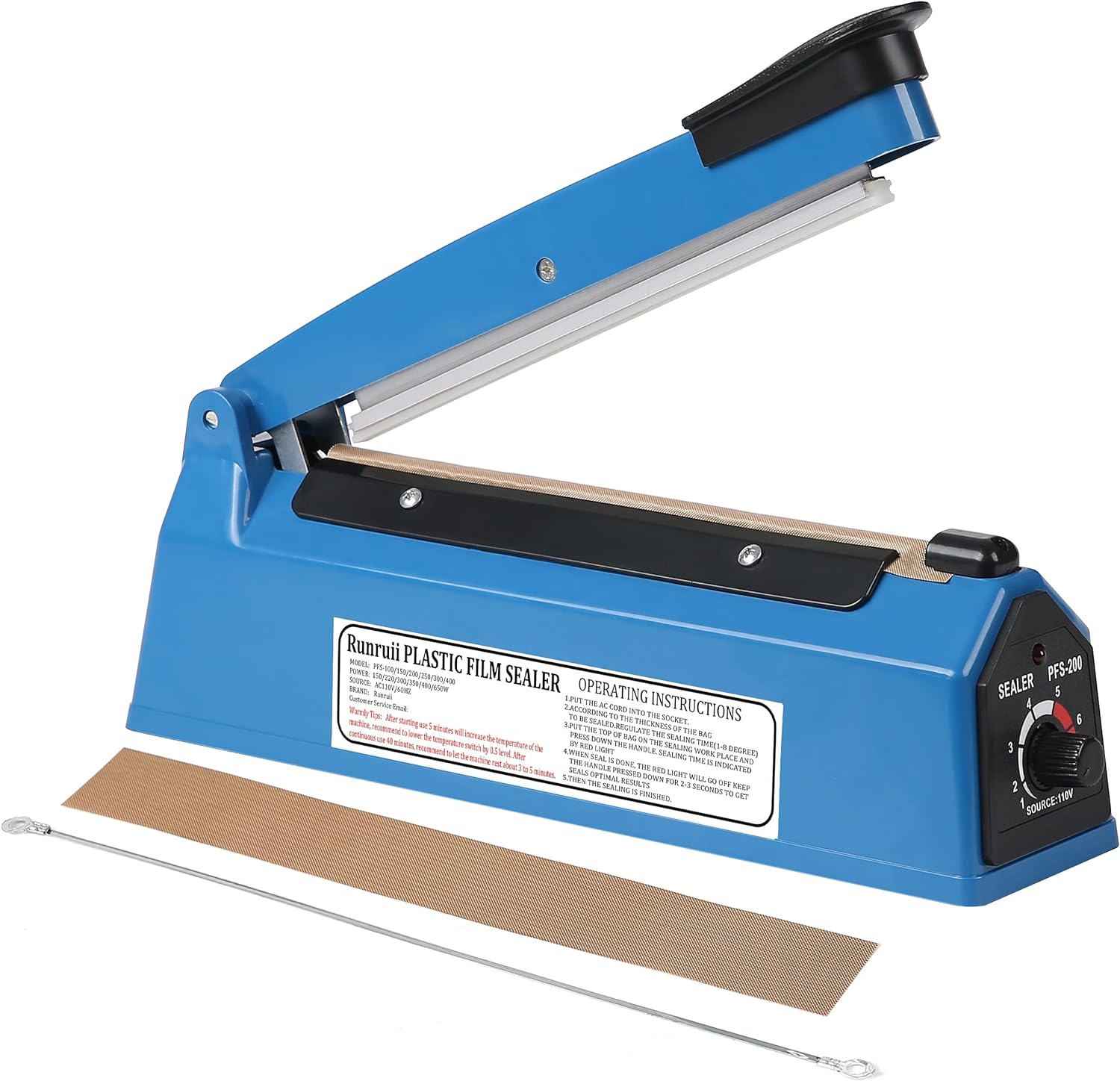 HEAT SEAL
12-Inch Manual Impulse Heat Sealer*
For closing compatible heat-sealable bags after a fully dry batch.
View on Amazon PORTION PACKAGING
Wallaby 1-Pint Gusset Mylar Bags — 50 Count*
Small heat-sealable portions can reduce repeated humidity exposure.
View on Amazon MOISTURE CONTROL
5 g Silica Gel Packets — 50 Pack*
A desiccant option. Keep packets sealed, follow directions and do not eat them.
View on AmazonAffiliate links · Your price stays the same.
For broader packaging equipment, see the Best Vacuum Sealer guide. Vacuum sealing is packaging, not a substitute for complete drying.
METHOD CHECK
Freeze dryer vs. dehydrator, freezer, dry ice and air fryer
| Method | What it does | True freeze-drying? | Candy result |
|---|---|---|---|
| Freeze dryer | Freezes product and removes ice under vacuum | Yes | Can create porous, crisp textures |
| Food dehydrator | Heat + airflow | No | Different drying process and texture |
| Kitchen freezer | Freezes product | No | Cold/hard; no vacuum drying |
| Dry ice | Provides intense cold | No, not by itself | Not a controlled freeze-dryer cycle |
| Air fryer / oven | Heat + airflow | No | May soften, cook or melt candy |
BUYING DECISION
Is a freeze dryer worth it if candy is your main goal?
If candy is the only thing you plan to make, a freeze dryer is difficult to justify on economics alone. The decision becomes more rational when candy is one use case among fruit, vegetables, ingredients, prepared foods or meals that your machine is designed to process.
FAQ
Freeze-dried candy FAQ
Can you freeze dry candy without a machine?
Not with the same controlled process. True freeze-drying requires freezing plus a vacuum stage that allows frozen water to leave by sublimation.
How long does candy take in a freeze dryer?
There is no universal time. Use your exact machine’s current process and verify doneness instead of relying on one internet timer.
What candy freeze dries best?
Simple sugar-based candies that contain enough moisture to transform often give the clearest first-batch feedback. Recipe differences still matter.
Does chocolate freeze dry well?
Chocolate-heavy candy is a weaker first choice because high-fat foods can respond poorly. Mixed candies can behave differently, so test small batches.
Why did my freeze-dried candy turn chewy?
The center may still contain moisture, or fully dry candy may have absorbed humidity after the cycle. Check the largest pieces and package promptly after the dry check passes.
SOURCES · VERIFIED 09/03/2026
Sources and manufacturer guidance
Safety and process statements are tied to current Extension guidance and manufacturer guidance for the machine or feature being discussed. Machine-specific values are not generalized across brands.
METHOD SWITCH
Want to freeze-dry regular food next?
Use the broader beginner guide for fruits, vegetables, cooked foods, dryness checks and storage.
Open the Freeze Dry Food guide →