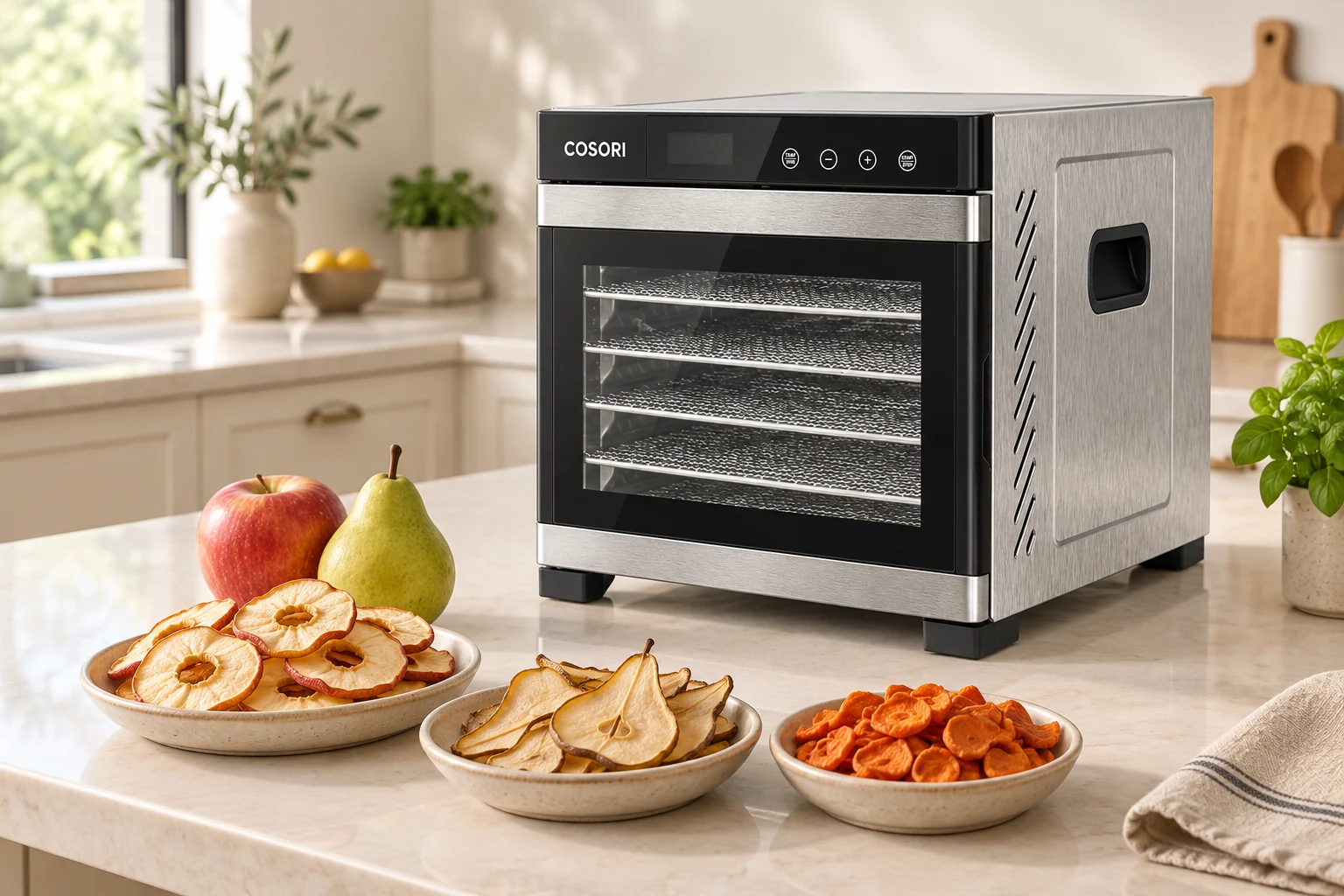
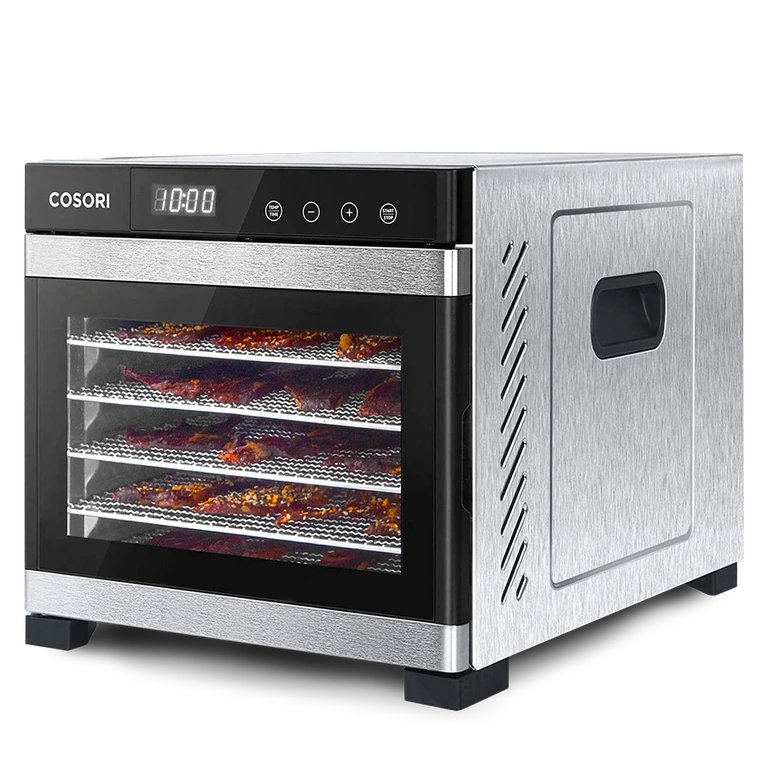
AI-generated mockup: cabinet dehydrator and example dried foods. Choose capacity around your own batches.
Choose a dehydrator around the food and batch size you regularly prepare. Useful tray area, accessible controls, cleaning and a workable place to run it matter more than the largest wattage or the longest list of presets. The right machine should make a normal batch easier, not persuade you to prepare far more food than you want.
This is a decision guide for choosing a format and specification. When you have a shortlist of requirements, use our food dehydrator comparison for individual models and their trade-offs. If you are completely new to drying, start with the dehydrating basics so the appliance choice follows the food process.
When does a dedicated dehydrator make sense?
Think about the last few batches you wanted to dry. Was the main frustration limited tray space, difficult temperature control, repeated oven checks or having your cooking appliance occupied for hours? A dedicated machine is worth considering when it solves a recurring problem like one of these.
For a small occasional experiment, first establish whether an appliance you already own is suitable for the specific food and recipe. Do not assume that any air fryer or oven can do the job: inspect its documented operating range and instructions. Conversely, do not buy a large dehydrator just to find out whether your family enjoys dried apple rings.
A seasonal grower has a different problem. Several boxes of produce arriving together make usable drying area and a planned sequence of batches more important. Write down your typical harvest volume and the time you can spend washing, preparing and checking it. Capacity is useful only when the rest of your routine can support it.
Three examples of different buying priorities
A household cabinet, a stackable format and a larger drying area.
EVERYDAY CABINET
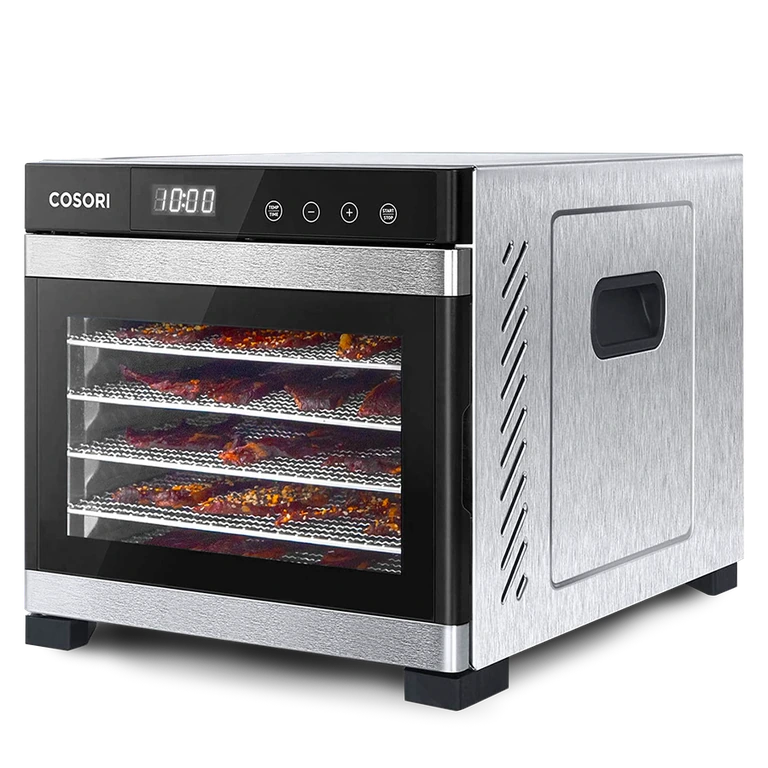
COSORI CP267-FD
Six stainless-steel trays, digital controls and front access for regular household batches.
Three real examples of different buying priorities
Familiar cabinet format: COSORI CP267-FD
The CP267-FD is a useful example of a household cabinet machine: COSORI lists six stainless-steel trays, a 95–165°F setting range and a timer up to 48 hours. Its stated outside dimensions are 13.4 × 17.8 × 12.4 inches, so measure the space before buying. COSORI: CP267-FD specifications.
The buying question is whether this amount of tray space fits your normal batch. If so, digital control and front access may be more useful than expanding immediately to a much bigger machine. View the COSORI on Amazon.
Stackable format: NESCO FD-75A
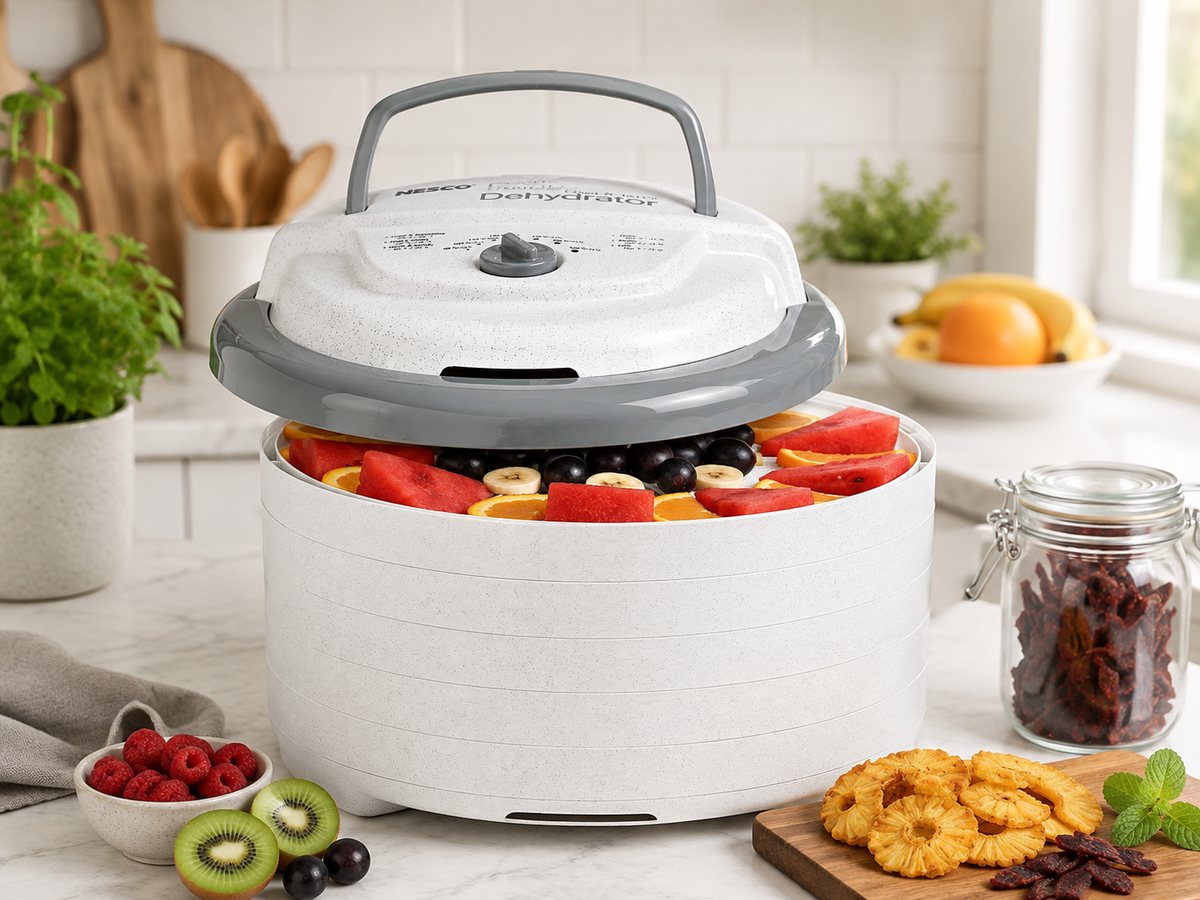
The NESCO FD-75A provides a stackable alternative to a front-access cabinet. Compare how you would load and check its trays with a cabinet's pull-out arrangement. The link identifies the FD-75A; check the exact model, included trays and accessories in the offer, because NESCO's current manufacturer catalog also uses the similar FD-75PR name. Do not treat matching appearance as proof of an identical bundle. NESCO: dehydrator catalog.
This is a practical option to investigate when a stackable layout fits your storage routine. Confirm the specification you need rather than buying on the assumption that every NESCO listing describes the same package. Check the FD-75A on Amazon.
Larger drying area: Excalibur DH10SCSS13
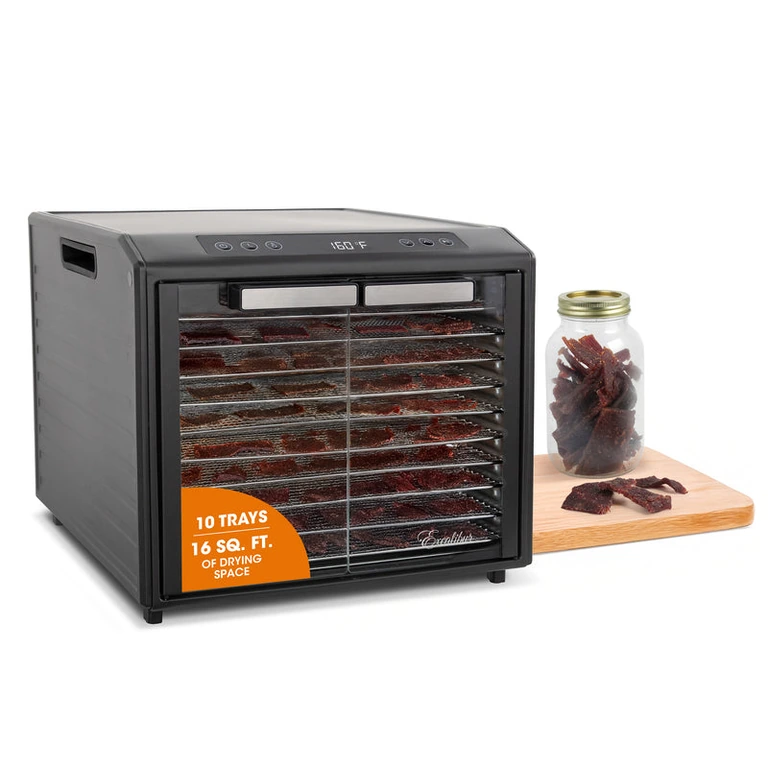
The DH10SCSS13 Select illustrates the larger-cabinet decision. The manufacturer's product information lists ten chrome trays and 16 square feet of drying area. The word “stainless” in the cabinet description should not be read as “stainless-steel trays.” Compare the exact model and tray material before ordering. Excalibur: Select 10-tray model.
Its extra area is relevant when you can use it. A large machine is not an automatic upgrade for a household that normally prepares one small batch. View the Excalibur on Amazon.
Affiliate links · Your price stays the same. If you buy through these links, Einfach Haltbar may earn a commission.
The buying criteria that matter
1. Compare usable tray area
Tray count is a starting point, not a capacity measurement. A stack of small round trays and the same number of larger rectangular trays do not necessarily hold comparable batches. Look for usable dimensions and note any center opening, raised edge or space needed for airflow.
Consider the foods you intend to load. Fruit leather needs a suitable solid sheet; small herbs or pieces may need a finer screen. These accessories can change the usable area and the number of trays you can equip at once. A machine with many trays but only one compatible fruit-leather sheet may need an extra purchase to support your plan.
2. Understand the airflow layout
Horizontal and vertical airflow describe the broad arrangement of heat and air movement. The National Center for Home Food Preservation describes horizontal-flow designs as placing the fan and heat source to the side, and explains practical differences such as heat distribution and dripping toward the heater. Use those distinctions to ask better questions about a model, rather than assuming a layout alone proves performance. NCHFP: food dehydrators.
Read the model's actual loading directions. Can you remove one tray easily? Where should a drip sheet go? Does the manual recommend rotation or spacing changes for the foods you plan to dry? A claim of even drying is not a reason to ignore differences between thick and thin pieces or an overloaded tray.
3. Match controls to your recipes
Check the lowest and highest settings, their adjustment steps and the timer's maximum duration. The display should be readable where the appliance will stand. Decide whether you want a simple dial or a digital timer based on how you work, not on which control panel looks more elaborate.
A timer ends a programmed run; it does not measure whether the food is dry enough. Likewise, a machine's highest setting does not establish the temperature reached inside every piece. Jerky requires a food-specific safety process, including the appropriate heat treatment, rather than reliance on a preset alone. NCHFP: jerky.
4. Look at every cleaning job
Inspect the trays, mesh screens, fruit sheets, drip area and interior corners. A removable tray that fits your sink may matter more in everyday use than a decorative finish. Check which individual parts are dishwasher-safe and which need hand washing; do not extend one material's instructions to the whole appliance.
Think about storage after washing as well. Large wet trays require drying space, and extra screens need a place where they stay flat and clean. These small practical details affect whether using the dehydrator feels straightforward or becomes a chore.
5. Measure the operating space
Measure width, depth, height and the room needed to open the door or lift the powerhead. Then add the clearances required by the manufacturer's manual. Do not plan to squeeze an appliance into a closed cupboard while it runs simply because its external dimensions fit.
If the machine will run in an open kitchen, consider where its sound will be heard. We have not measured these models' noise under identical conditions, so no numerical quietness ranking is given here. Look for a clear return policy and consider the actual place you will use it.
Which size fits your routine?
Your routine
Prioritize
Avoid
Occasional small snack batches
Easy setup, usable controls and storage
Buying capacity you rarely load
Regular fruit, vegetables and herbs
Enough tray area plus suitable screens and sheets
Choosing only by the number of trays
Seasonal garden harvests
Batch planning, larger usable area and straightforward cleaning
Assuming one large run removes the need for checks
Jerky-focused use
A suitable appliance and complete, research-based heat-and-drying method
Treating a jerky button as a safety guarantee
Accessories and ownership costs
Start with the accessories your main foods actually need. Check the fit of screens and fruit-leather sheets against the exact tray model, and include their cost when comparing otherwise similar machines. Replacement trays, customer support and an available manual are more useful ownership details than an impressive accessory count alone.
Do not estimate electricity use from rated wattage alone. Power cycling, the drying conditions and run duration affect consumption. If operating cost is important to your choice, compare measured data collected under a relevant, clearly described method; without those data, a precise cost-per-batch claim would be misleading.
Make the final choice
Write a one-sentence requirement: “I want to dry this food, in this usual quantity, in this part of my kitchen.” Add the tray area, controls, cleaning needs and accessories required to support it. That gives you a shortlist you can defend without getting distracted by every additional program.
Then open Best Food Dehydrators to compare concrete options. For meat-focused shopping, continue to Best Dehydrator for Beef Jerky. Choose the machine that fits your repeatable routine, and use the recipe to guide every batch afterward.
 EVERYDAY CABINET
 STACKABLE FORMAT
 LARGER DRYING AREA
 Best Food DehydratorsCompare specific models once you know the format and capacity you need.