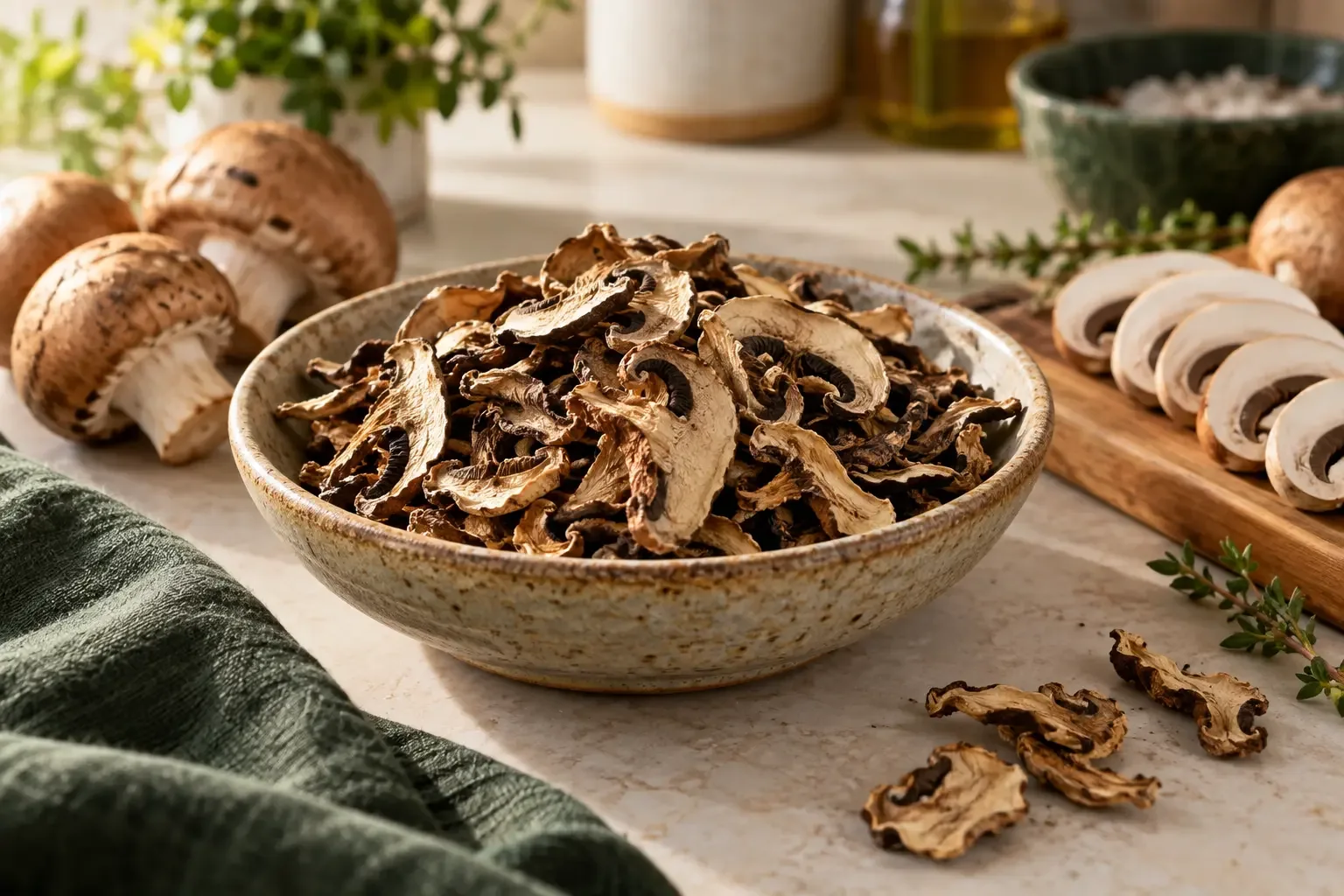
Dehydrating mushrooms is one of the easiest ways to turn a short-lived ingredient into a compact pantry staple for soups, sauces, risotto and mushroom powder. For cultivated edible mushrooms, a practical starting point is about 125°F (52°C) in a food dehydrator, with the final drying time determined by slice thickness, mushroom type, airflow and how heavily the trays are loaded.
The most important rule is not the timer: the mushrooms need to be fully dry before storage. Cool a few pieces and test the thickest sections. Properly dried slices should feel dry all the way through and break or snap rather than bend with a damp center.
If you are working with wild mushrooms, safety comes first. Penn State Extension warns that only an expert can reliably distinguish poisonous from edible mushrooms and that poisonous mushroom toxins are not destroyed by drying or cooking. If a wild mushroom is not positively identified by a qualified expert, do not eat or preserve it.
Download the free Einfach Haltbar dehydration chart for quick reference on your next drying project.
Product testing note: We did not personally test these products. The gear below is selected from the Amazon.com links supplied for this article and checked for relevance to the task described. Product listings, included accessories and specifications can change, so verify the current Amazon listing before buying.
Which mushrooms are best for dehydrating?
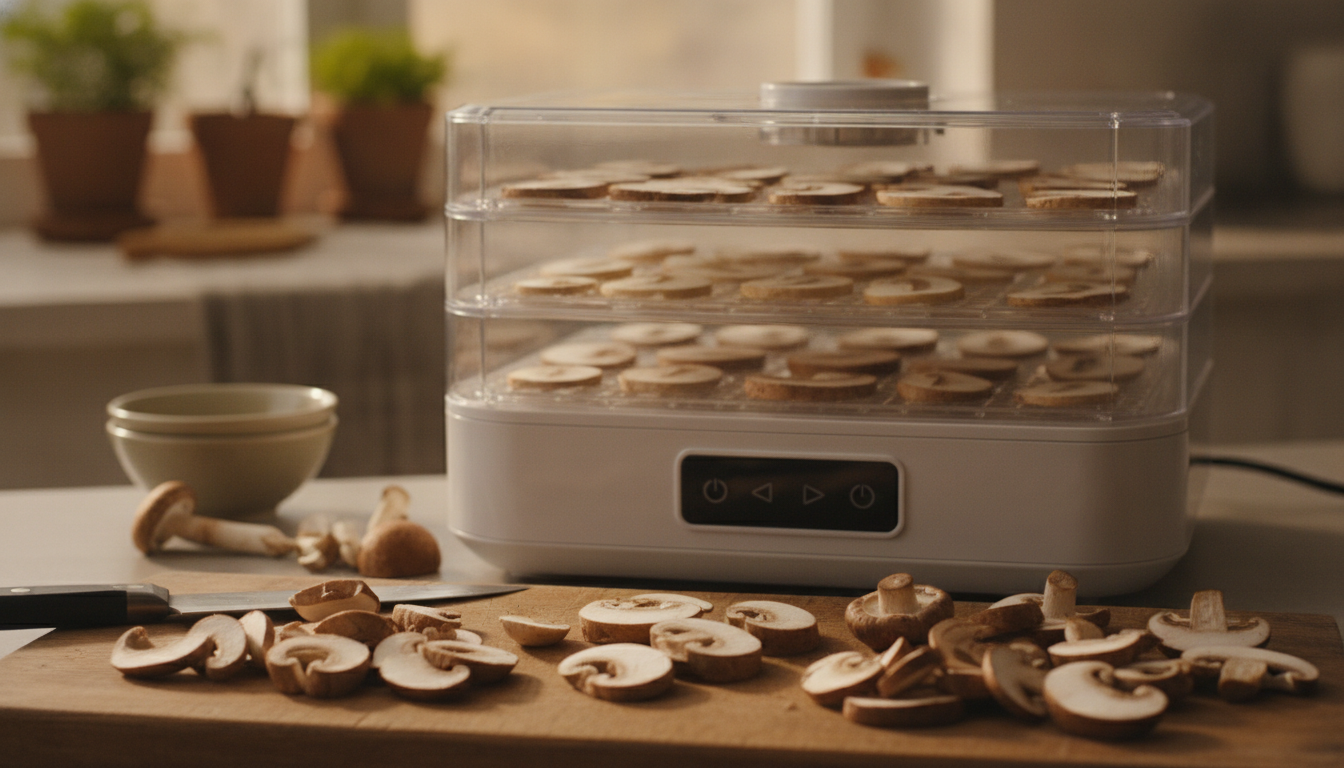
For a first batch, cultivated mushrooms are the simplest choice because their identity and condition are easier to judge. White button mushrooms, cremini, portobello, shiitake, oyster mushrooms and king oyster mushrooms can all be dried when they are fresh and free from decay.
- Button and cremini mushrooms: easy to slice evenly and useful in soups, sauces and powder.
- Portobello: remove any tough stem base and cut the cap into even slices.
- Shiitake: dry the caps; very tough stems can be separated for stock or powder if appropriate.
- Oyster mushrooms: separate clusters into pieces of similar thickness so thinner edges do not overdry while thick centers stay moist.
- King oyster mushrooms: slice lengthwise or crosswise into uniform pieces.
Start with mushrooms that are firm and fresh. Penn State recommends discarding produce that shows bruising, damage or contamination. Drying is a preservation method, not a way to rescue mushrooms that are already slimy, moldy or spoiled.
Wild mushroom safety: identification comes before preservation
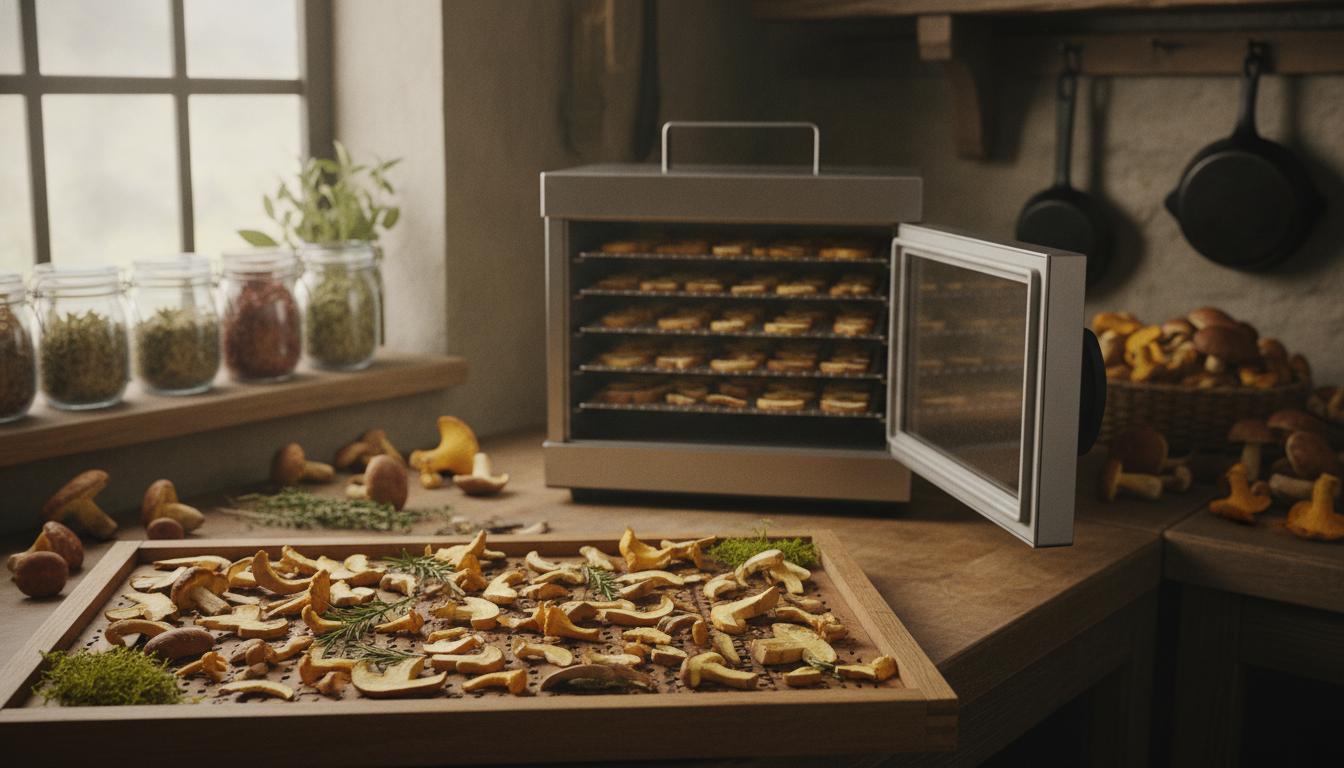
Do not use dehydration as a safety step for an uncertain wild mushroom. Penn State Extension states that only an expert can differentiate poisonous and edible mushrooms and that toxins in poisonous varieties are not destroyed by drying or cooking. Utah State Extension gives the same warning in its home-drying guidance.
If you forage, learn from a qualified local expert or mycological organization and follow local regulations. A field guide can support learning, but it should never be treated as the only basis for deciding that a wild mushroom is edible.
Three tools for preparing mushrooms
These tools can make field collection and surface cleaning more convenient, but they do not identify whether a wild mushroom is edible. We did not personally test these products. Verify the exact current Amazon listing before buying.

DRACHENADER Mushroom Foraging Kit
A mushroom-specific kit with a breathable mesh collecting bag, folding knife with brush and adjustable carrying strap according to the current listing.
View on Amazon
DRACHENADER Mushroom Knife with Brush
A folding mushroom-foraging knife with an integrated brush for trimming and cleaning in the field. Check the current listing for the exact blade and included accessories.
View on Amazon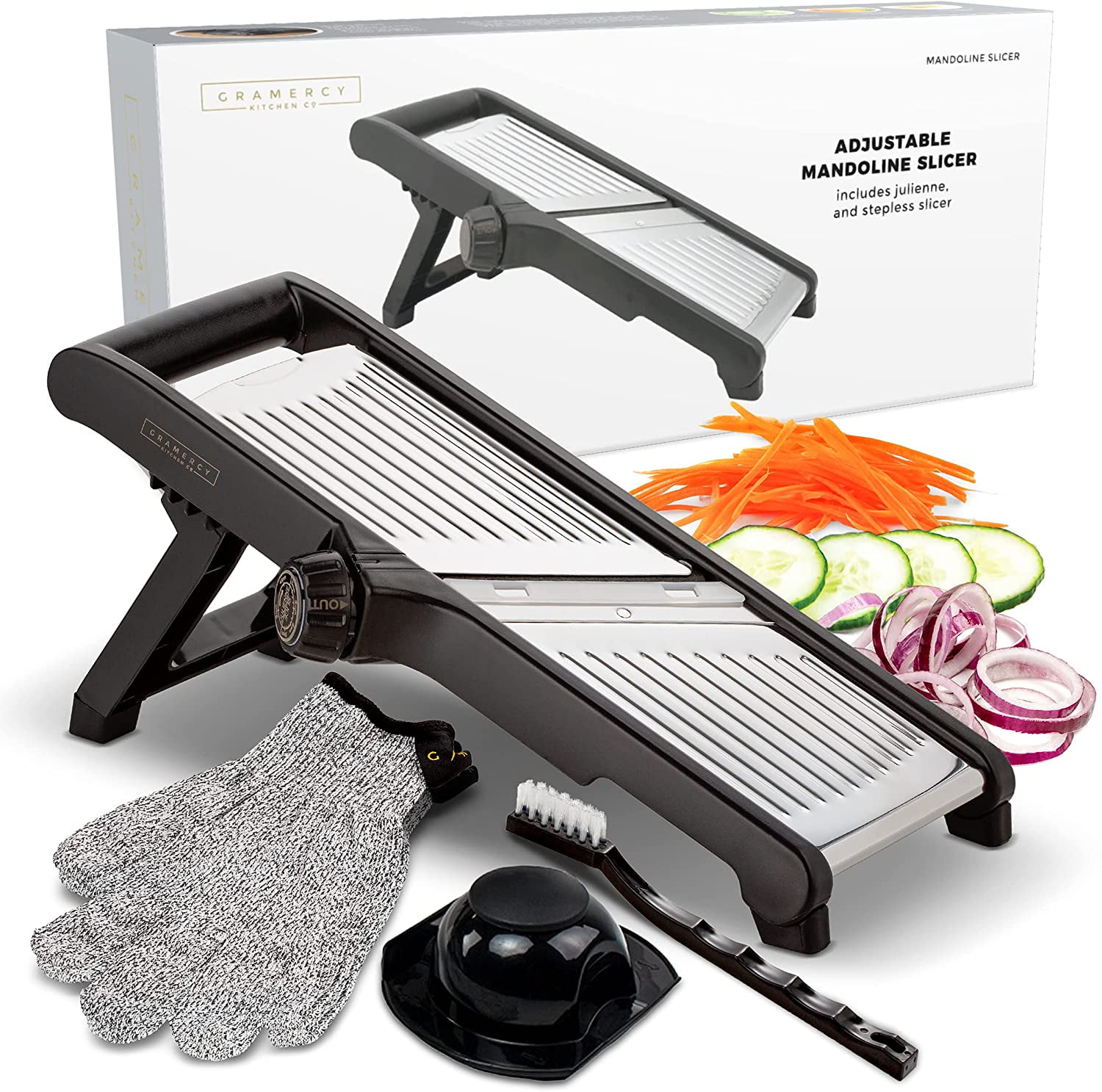
Gramercy Mandoline Slicer
Adjustable stainless-steel slicer supplied with a food holder and cut-resistant gloves according to the current listing.
View on AmazonAffiliate links · Your price stays the same.
How to clean and slice mushrooms for dehydrating
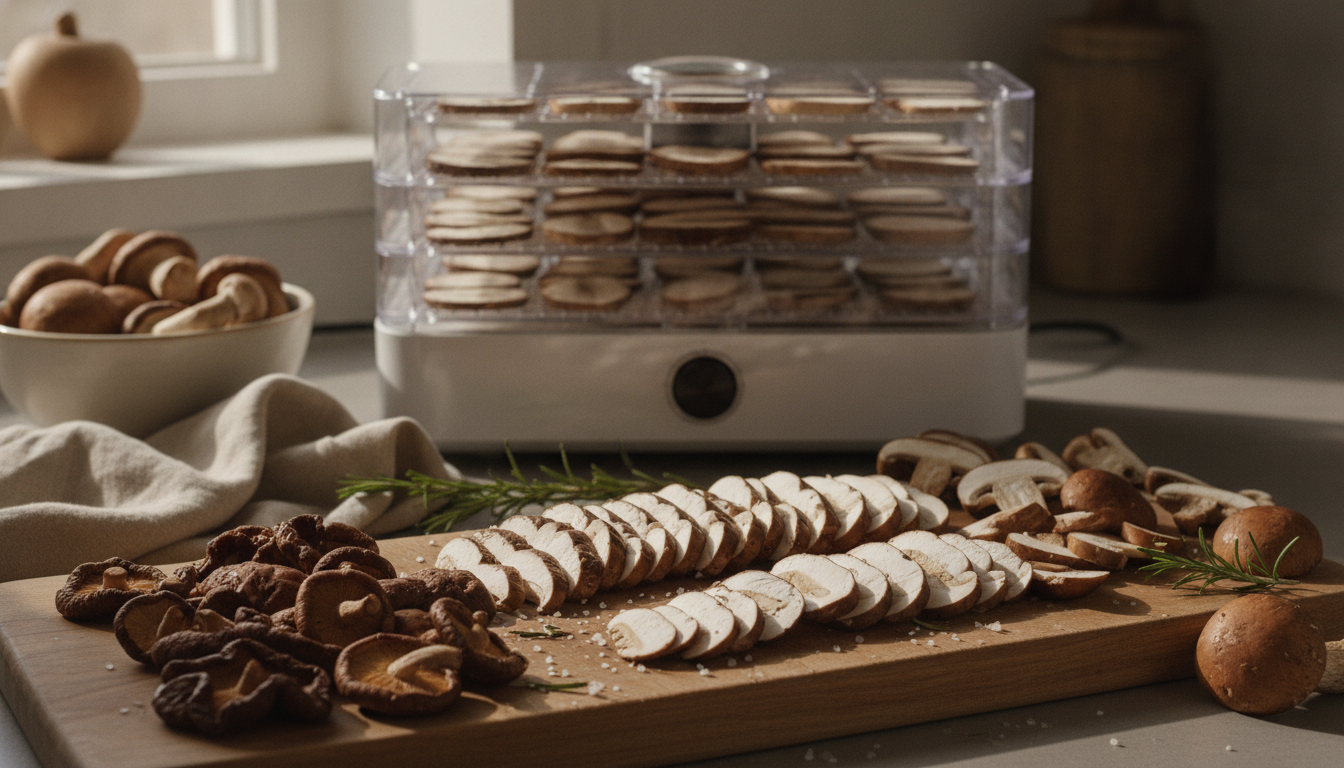
Clean off dirt and trim damaged areas
Brush or wipe away loose soil first. Penn State's preservation guidance summarizes NCHFP directions to scrub mushrooms well and discard woody stalks. If the mushrooms need rinsing, use cold water and dry the surfaces well before loading the trays.
Slice for even drying
Uniformity matters more than chasing one exact measurement. A thickness around 1/8 to 1/4 inch works well for many cultivated mushrooms. Thin slices dry faster; thick pieces need longer and are more likely to hide moisture in the center.
For larger batches, a mandoline can make thickness more consistent, but the blade is extremely sharp. Always use the food holder or hand guard supplied with the slicer and follow the manufacturer's safety instructions.
A mandoline can speed up large batches
For a bowl of mushrooms, a chef's knife is enough. For repeated large batches, an adjustable slicer can make thickness more consistent. We did not personally test this product.
Gramercy Mandoline Slicer
Adjustable stainless-steel slicer supplied with a food holder and cut-resistant gloves according to the current listing.
View on AmazonHow to dehydrate mushrooms in a food dehydrator
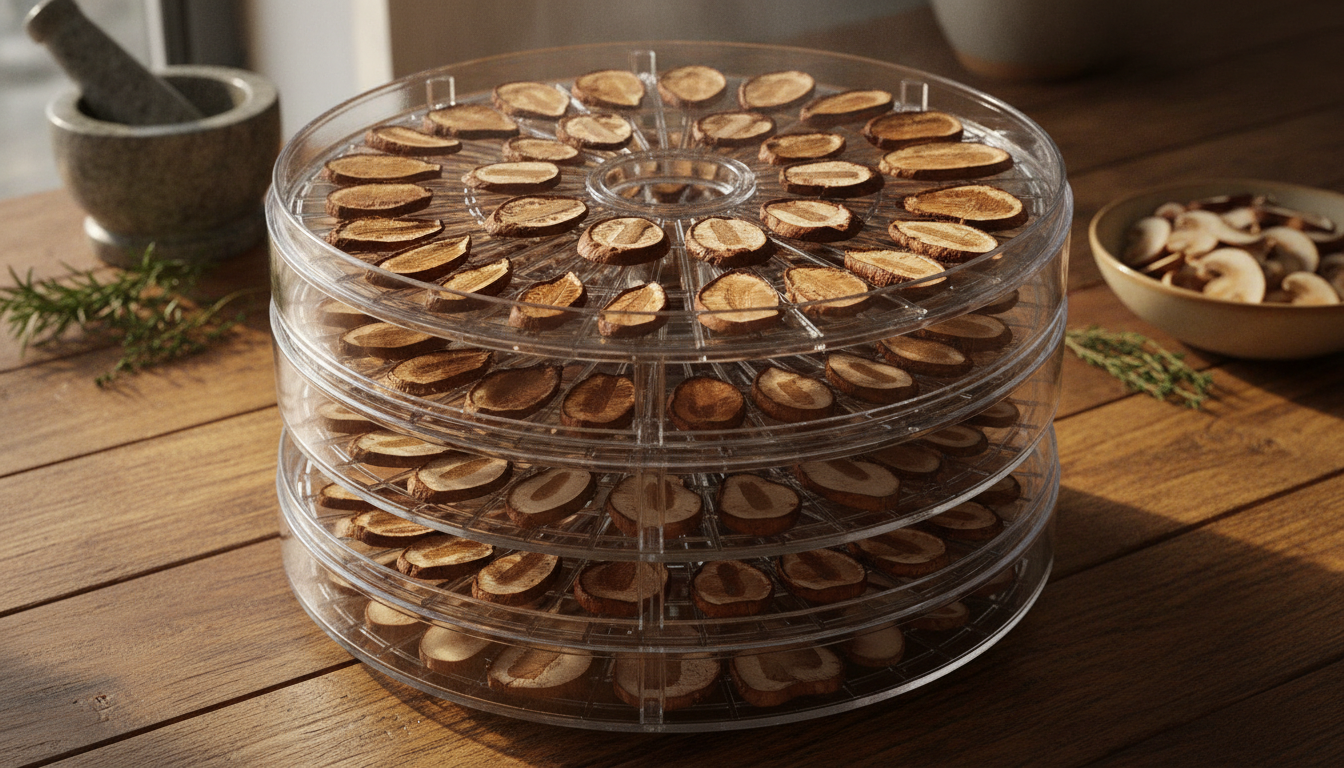
- Prepare the dehydrator. Make sure the trays are clean and the machine has room around its vents.
- Arrange one layer. Spread mushroom slices without overlapping them. Air needs to move around the food.
- Set the temperature. A practical home-dehydrator starting point is 125°F (52°C). If your dehydrator manual gives a mushroom setting, follow the manufacturer's instructions.
- Check during the run. Drying is not perfectly uniform. Rotate trays only if your machine's airflow pattern or manual calls for it, and remove thin pieces that finish early.
- Cool and test. Do not decide by time alone. Cool a few of the thickest pieces and check that the centers are fully dry.
A dehydrator is usually easier to control than an oven because it combines low heat with forced airflow. If you dehydrate fruit, vegetables or jerky as well, compare capacity and temperature control in our Best Food Dehydrators guide.
Mushroom dehydrating temperature and time
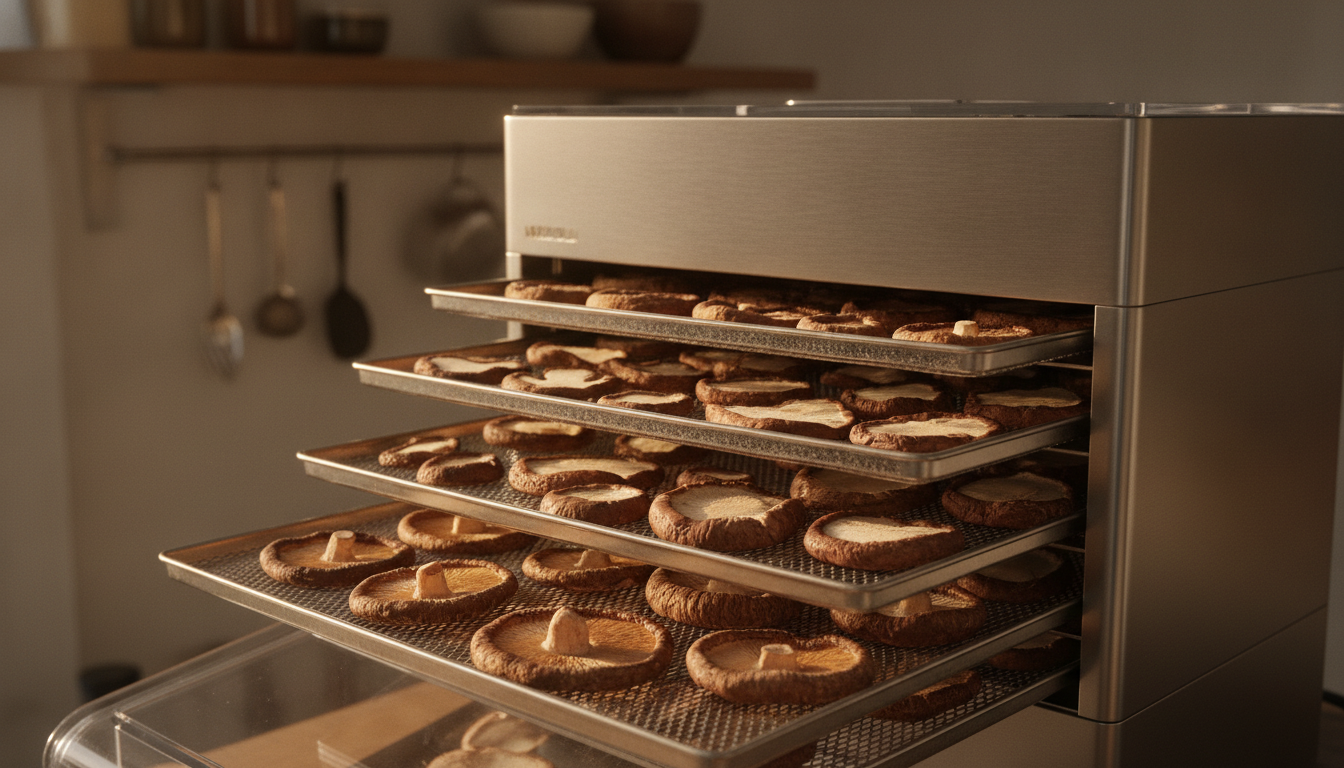
There is no single time that works for every batch. Penn State's current mushroom-preservation article summarizes NCHFP guidance as 8–10 hours in a dehydrator. Excalibur's mushroom instructions use 125°F and give a shorter 3–7 hour range for 3/8-inch slices, while REI lists about 6–8 hours for 1/8-inch slices at 125°F. Those differences are exactly why the dryness test matters more than the clock.
| Mushroom / cut | Starting temperature | Planning range | Done when … |
|---|---|---|---|
| Button or cremini, thin slices | 125°F / 52°C | roughly 4–10 hr | cooled slices are dry through the center and break rather than bend damp |
| Portobello, even slices | 125°F / 52°C | roughly 6–10+ hr | the thickest areas have no soft or moist core |
| Shiitake caps | 125°F / 52°C | roughly 5–10 hr | caps are fully dry and brittle after cooling |
| Oyster / king oyster pieces | 125°F / 52°C | roughly 5–10+ hr | thicker stem sections are dry all the way through |
If your machine runs hotter or cooler than its display suggests, the batch may finish earlier or later. Treat the table as a planning tool, not a safety guarantee. The final check is always the cooled mushroom itself.
Keep common dehydration settings and dryness checks in one place for your next batch.
Can you dry mushrooms in the oven?
Yes, but a conventional oven is less efficient at low-temperature drying than a dehydrator. The National Center for Home Food Preservation notes that oven drying is typically slower because most ovens do not move air as effectively as a dehydrator. Penn State says mushrooms can be oven-dried if the thermostat can hold about 140°F, with the door propped open 2–6 inches and a fan outside the oven to help move moist air away.
- Arrange prepared mushrooms in a single layer on racks or trays.
- Use the lowest controlled oven temperature recommended by your extension guidance and appliance manual.
- Allow moisture to escape safely. Never create a setup that conflicts with your oven manufacturer's instructions.
- Check frequently because oven hot spots can dry edges faster than centers.
- Cool test pieces before deciding they are dry enough for storage.
If your oven cannot maintain a low drying temperature or you plan to preserve food regularly, a thermostatically controlled dehydrator is the easier option.
How do you know dehydrated mushrooms are dry enough?
The biggest storage mistake is packing mushrooms while the center is still moist. Heat can make a slice feel drier than it really is, so let a few test pieces cool first.
- Ready: no cool, damp or spongy center; slices are dry and brittle after cooling.
- Needs more time: flexible in the middle, rubbery, soft at the stem or visibly moist.
- Check the thickest pieces: do not judge the whole batch by one thin edge piece.
- Watch the container: if you later see condensation, remove the mushrooms immediately and reassess the entire batch.
If dried mushrooms later develop visible mold, a clearly spoiled odor or other signs of spoilage, discard them. Dehydration reduces available moisture; it does not make poor storage conditions harmless.
How to store dehydrated mushrooms
Let the mushrooms cool completely before sealing them. Store fully dried mushrooms in clean, dry, airtight containers away from heat, moisture and direct light. Clear jars are convenient for checking the contents, but keep them in a dark cabinet rather than on a sunny counter.
For larger batches, divide the mushrooms into smaller portions so you do not repeatedly expose the entire supply to humid room air. A vacuum sealer can help with portioning, but vacuum sealing is not a substitute for adequate drying. If the mushrooms still contain moisture, sealing them tightly does not fix the problem.
Airtight jars or vacuum-sealed portions
Use whichever format fits your pantry. The mushrooms must already be fully dry and cool before either method. We did not personally test these products.
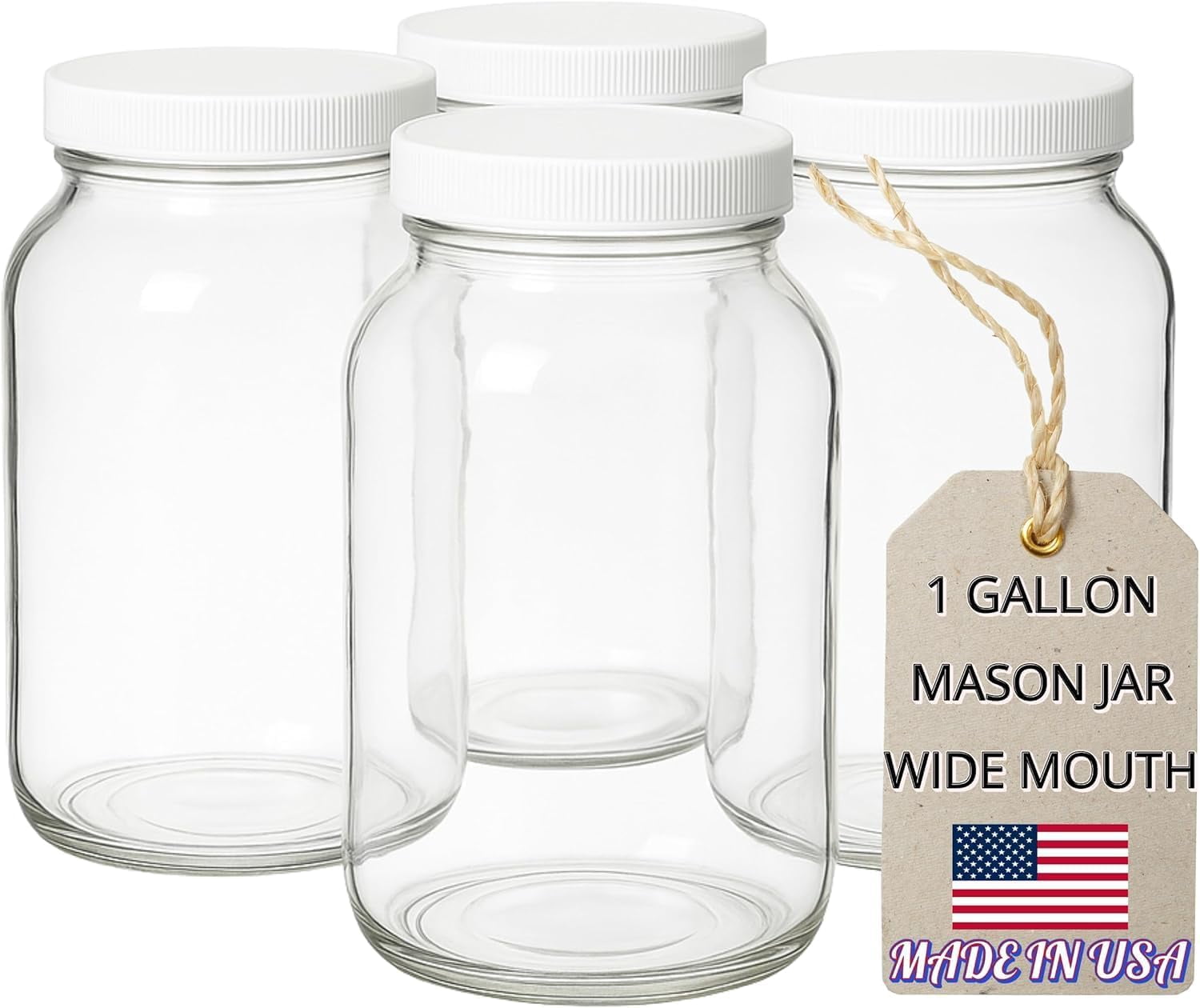
1-Gallon Glass Storage Jars
Large clear jars for keeping fully dried pantry ingredients visible and organized.
View on Amazon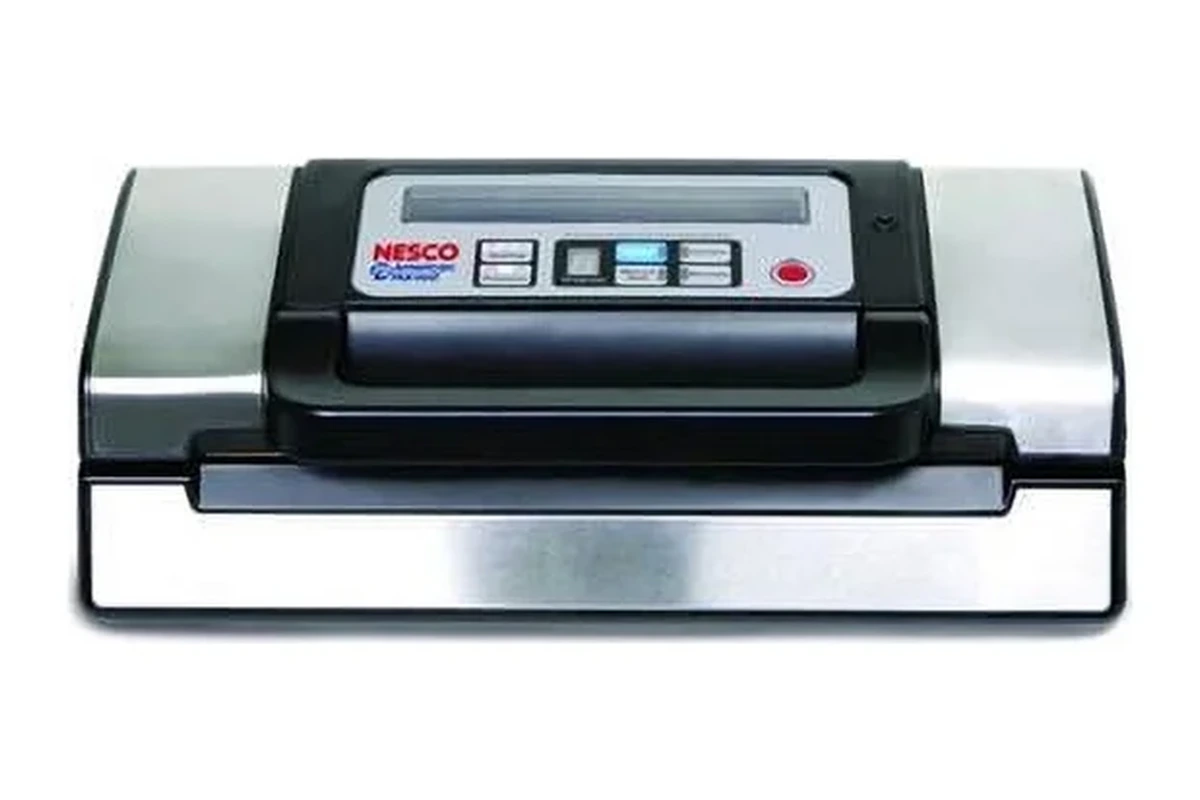
NESCO VS-12 Vacuum Sealer
An external vacuum sealer with pulse control and double-seal capability for portioning properly dried foods.
View on Amazon
Wallaby 1-Pint Mylar Bags — 50 Count
Heat-sealable 1-pint Mylar bags for portioning a completely dry batch and limiting repeated humidity exposure.
Packaging cannot make under-dried food safe. Verify dryness first, then seal promptly.
View on AmazonAffiliate links · Your price stays the same.
If vacuum storage interests you beyond mushrooms, see our Best Vacuum Sealer 2026 comparison.
How to rehydrate and use dried mushrooms
For soups, sauces, rice dishes and braises, place the amount you need in a bowl and cover with warm water until the pieces soften. The exact soaking time depends on thickness, but many thin slices soften in roughly 20–30 minutes.
The soaking liquid can carry a lot of flavor. If you want to use it in a sauce or soup, pour it off carefully and strain it through a very fine filter to remove grit. Then cook the rehydrated mushrooms as appropriate for the variety and recipe. Dehydration is a drying process, not a cooking step.
How to make mushroom powder
Fully dried mushrooms can be ground into a concentrated seasoning for soups, sauces, gravies and savory rubs. The key word is fully: pieces for powder should be crisp enough to grind cleanly rather than smear or clump.
- Dry the mushrooms until brittle after cooling.
- Let them cool completely.
- Grind in a clean spice grinder, blender or food processor that is suitable for dry ingredients.
- Wait briefly before opening the grinder so fine powder can settle.
- Store the powder airtight and protect it from moisture.
Helpful gear for dehydrating mushrooms
You do not need a long shopping list to dry mushrooms. A knife, trays, controlled airflow and airtight storage cover the basics. The products below make the process easier when you dehydrate regularly or process larger batches.
Three dehydrators for different batch volumes
The larger six-tray model offers more drying area; the five-tray model is easier to fit into a smaller kitchen. We did not personally test these products. Confirm the exact current Amazon model and included accessories before ordering.
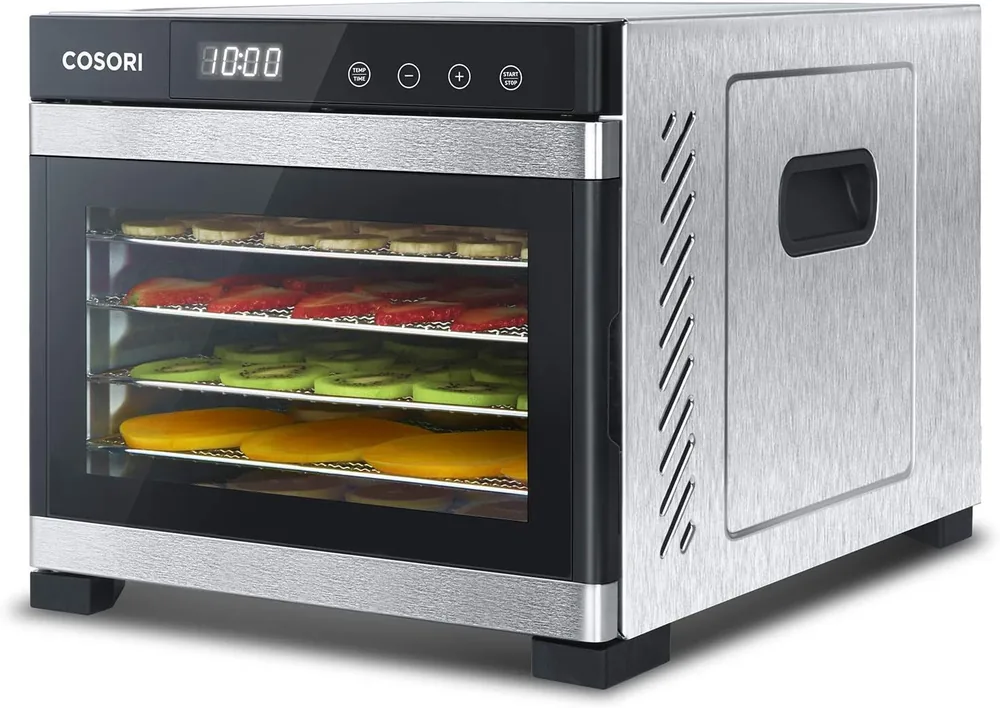
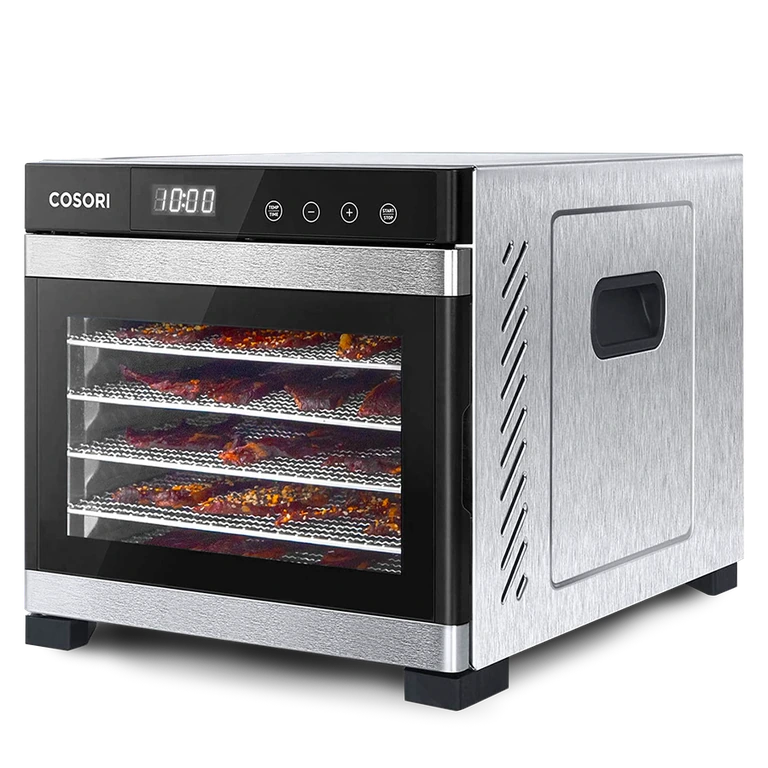
COSORI 6-Tray Stainless Steel Dehydrator
Six stainless-steel trays and a rear-fan cabinet format for larger home batches.
View on Amazon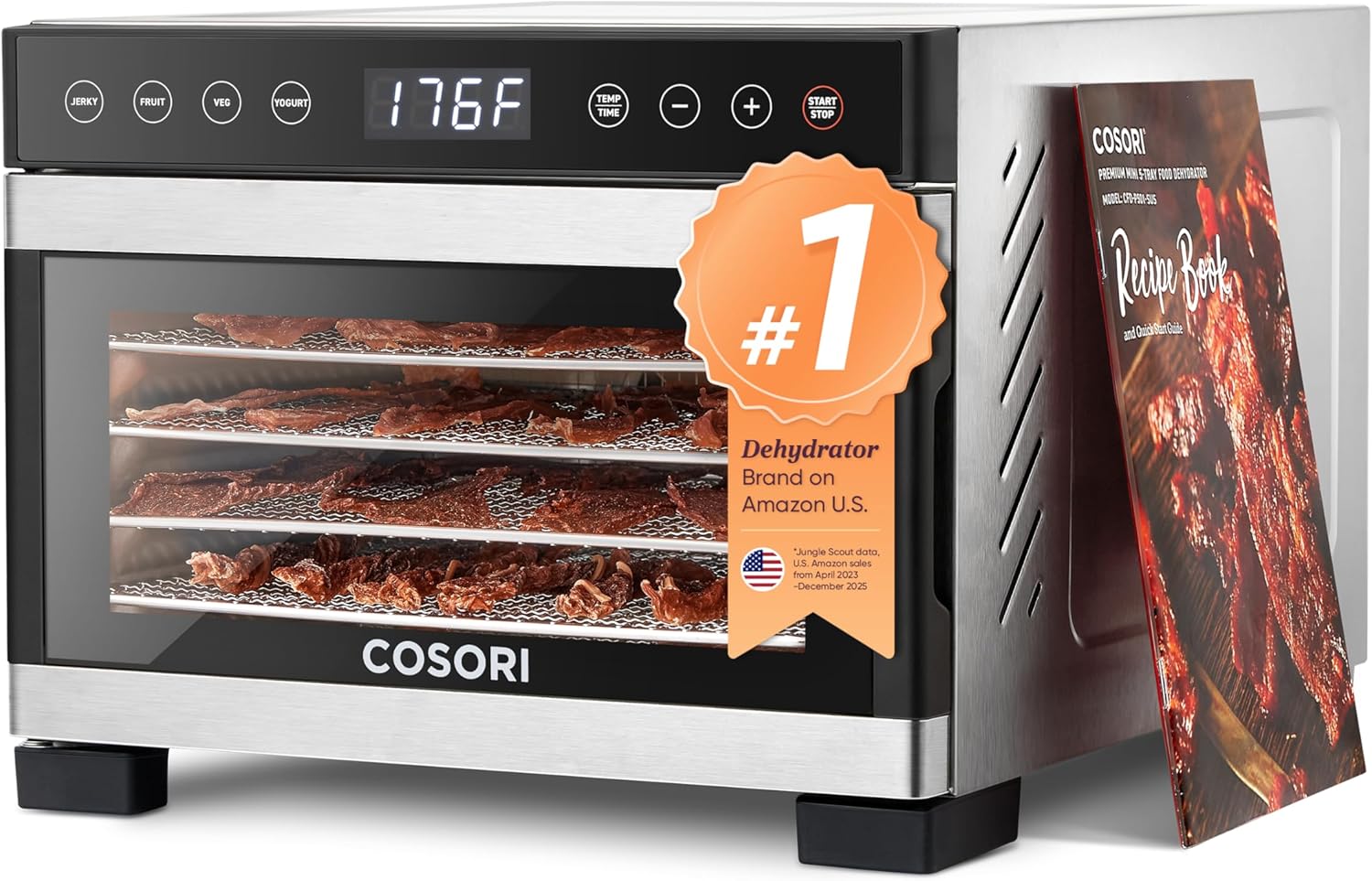
COSORI 5-Tray Stainless Steel Dehydrator
A smaller five-tray cabinet for everyday drying when counter and storage space matter.
View on Amazon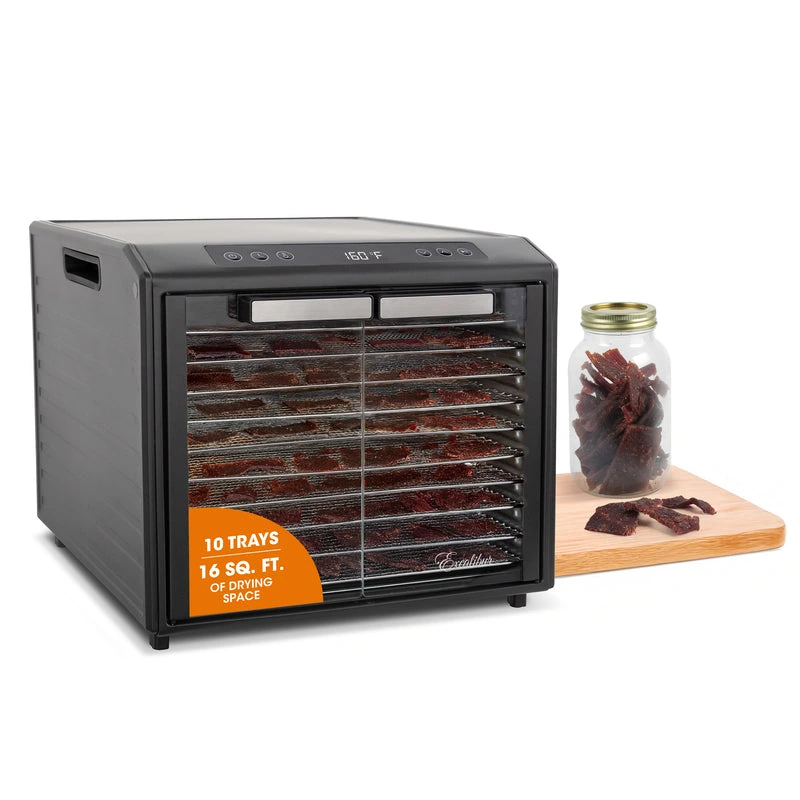
Excalibur Performance Series 10-Tray
Ten stainless steel trays, adjustable temperature control and a glass-door cabinet format suit readers who regularly prepare larger batches.
View on AmazonAffiliate links · Your price stays the same.
Fine-mesh liners help keep small dried pieces on the tray
Perforated mesh sheets can be useful for small mushroom pieces or powder-bound scraps that might otherwise fall through wide tray openings. They are not necessary for ordinary slices.

Lova 14 × 14-Inch Silicone Dehydrator Sheets, 12-Pack
Reusable fine-mesh liners that can be trimmed to fit different tray sizes; useful for smaller pieces.
View on AmazonA cookbook and foraging reference for experienced learners
A book can broaden your knowledge of mushroom cooking and preservation, but it does not replace expert identification of a wild specimen.
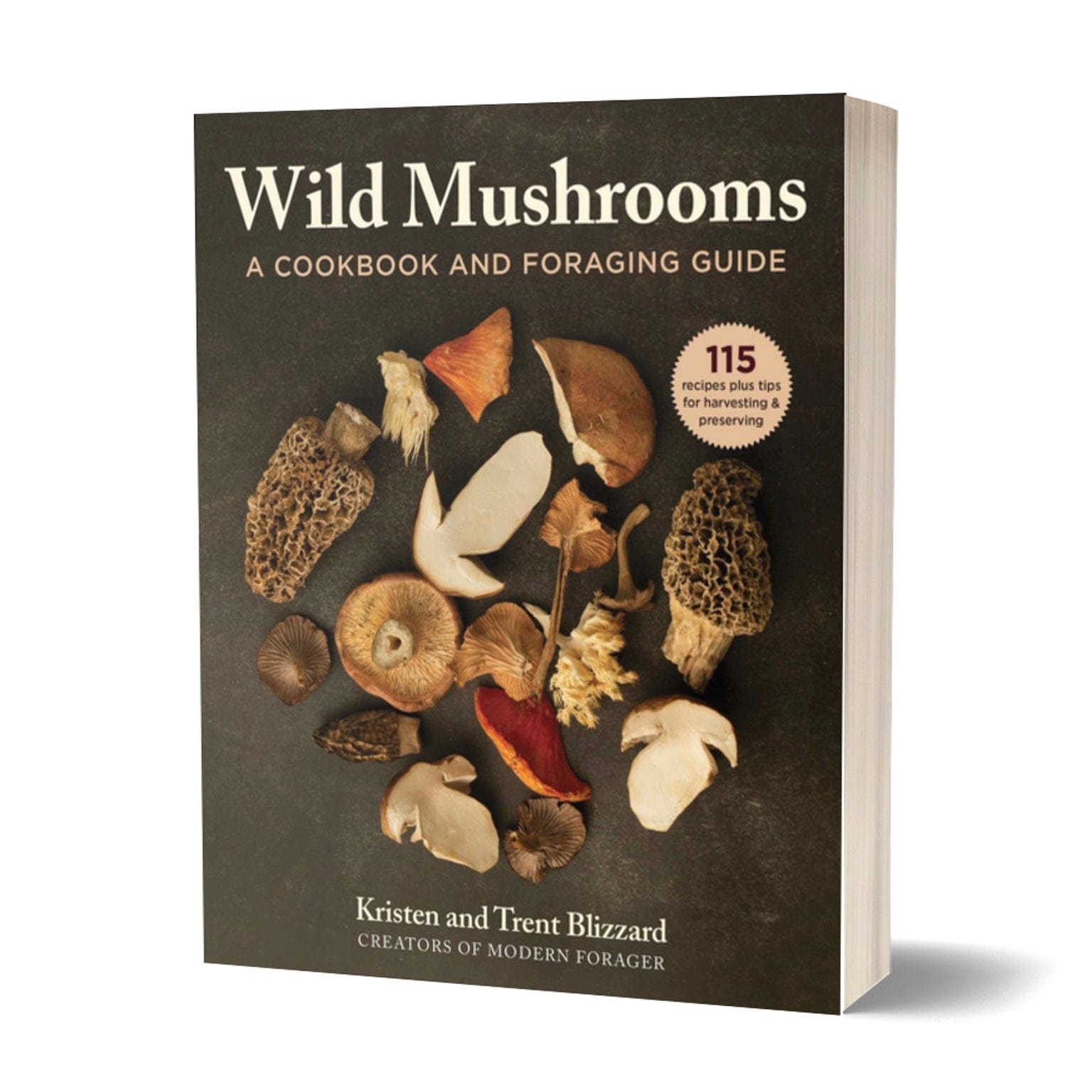
Wild Mushrooms: A Cookbook and Foraging Guide
A recipe-focused mushroom book with harvesting and preserving material. Use expert identification resources for any wild mushroom safety decision.
View on AmazonCommon mushroom dehydrating mistakes
- Starting with questionable mushrooms: dehydration cannot make spoiled or unidentified mushrooms safe.
- Uneven cuts: thin edges finish while thick centers stay moist.
- Overloading trays: blocked airflow slows moisture removal.
- Trusting the clock instead of the food: drying times are estimates.
- Sealing while warm: warm food can create condensation inside the container.
- Storing a mixed batch without checking thick pieces: a few under-dried slices can compromise the container.
- Using a vacuum sealer as a substitute for drying: vacuum packaging cannot correct residual moisture.
FAQ: dehydrating mushrooms
What temperature should I use to dehydrate mushrooms?
125°F (52°C) is a practical starting point used by multiple dehydrator guides and manufacturers. Follow the settings in your dehydrator manual if they differ, and judge completion by the cooled mushrooms rather than the display alone.
How long do mushrooms take in a dehydrator?
Plan for several hours. Penn State summarizes NCHFP mushroom-drying guidance at about 8–10 hours, while manufacturer and outdoor-food guides give shorter ranges for thin slices. Thickness, mushroom moisture, airflow and load size explain much of the variation.
Should I wash mushrooms before dehydrating?
Remove loose dirt first. If washing is needed, use cold water and dry the surface well afterward. Penn State's preservation guidance says mushrooms should be scrubbed well before drying.
Do I need to blanch mushrooms before dehydrating?
Penn State's current NCHFP summary says steam- or water-blanching is not needed for its mushroom-drying method. Some extension tables publish different pretreatment procedures, so if you are following a specific tested extension recipe, use that recipe as written rather than mixing methods.
Does drying make a poisonous mushroom safe?
No. Penn State and Utah State both warn that poisonous mushroom toxins are not destroyed by drying or cooking. Only preserve wild mushrooms that have been positively identified as edible by appropriate expertise.
Can I use dehydrated mushrooms without rehydrating them first?
For soups and long-cooked dishes, small dried pieces can sometimes go directly into the cooking liquid. For other recipes, soaking first gives you more control over texture. Follow the recipe and cook the mushroom variety appropriately.
How should I store mushroom powder?
Use a clean, dry, airtight container and keep it away from humidity, heat and direct light. Grind only mushrooms that were completely dry before processing.
Sources and further reading
For more English food-preservation guides, visit the Dehydrating hub, learn how to dehydrate tomatoes, or browse the full English hub.